
I Avenged 1999: Photographing Cornwall’s 95% Solar Eclipse
At Wheal Uny, the evening did not suddenly become night.
Instead, the light became wrong.
The sky remained blue, the Sun was still high above the western horizon and the landscape around me was clearly visible. Yet everything appeared subdued, as though an enormous pair of sunglasses had been placed over Cornwall.
After twenty-seven years, I was finally watching a solar eclipse beneath clear Cornish skies.
The Eclipse That Cornwall Never Gave Me
Like many people in Cornwall, I remember the total solar eclipse of 11 August 1999—but not necessarily for the reasons I would have liked.
Cornwall was supposed to have one of the best views in Britain. Instead, much of the country found itself beneath a blanket of cloud. Daylight faded, the temperature dropped and the landscape briefly fell into shadow, but the great celestial alignment itself remained hidden.
I had carried that disappointment with me ever since.
When I learned that a major partial solar eclipse would be visible from Cornwall on 12 August 2026, with approximately 95–96% of the solar disc obscured, it felt like an opportunity to settle an old score.
The only question was where to photograph it.
Planning an Eclipse Over Carn Brea
Carn Brea was the obvious subject.
Its granite ridge, castle and Basset Monument form one of the most recognisable landscapes in this part of Cornwall. My original thought was to photograph from the Carn itself, but access is limited, parking is scarce and I expected it to become busy.
Trying to operate two cameras during my first serious attempt at a solar eclipse was already going to create enough pressure. I did not need to add a crowded location to the equation.
Instead, I crossed the valley to Wheal Uny.
From there, Carn Brea sits roughly half a mile away. That distance allowed me to use a long lens to compress the perspective and make the filtered Sun appear more significant against the ridge.
It also gave me space to run a second camera for a wider timelapse.
I arrived several hours before first contact. There is an old rule in life: snooze you lose. I wanted time to choose my exact position, prepare both cameras and solve any problems before the eclipse began.
Two Cameras and One Solar Filter
My principal camera was a Canon EOS R fitted with the Canon 100–400mm lens and a K&F solar filter.
The solar filter was essential. Cornwall would not experience totality at any point, which meant the filter had to remain securely attached whenever the lens was directed towards the Sun.
That camera would capture the detailed stages of the Moon crossing the solar disc, including the sunspots visible across its surface.
My Canon 6D was set up alongside it with the 24–105mm lens. Its purpose was different. Rather than recording close views of the eclipse, it would photograph the broader landscape and the changing quality of light over Carn Brea.
I had never attempted a daytime timelapse quite like this before. There were no guarantees that it would work, but that uncertainty was part of the experience.
First Contact
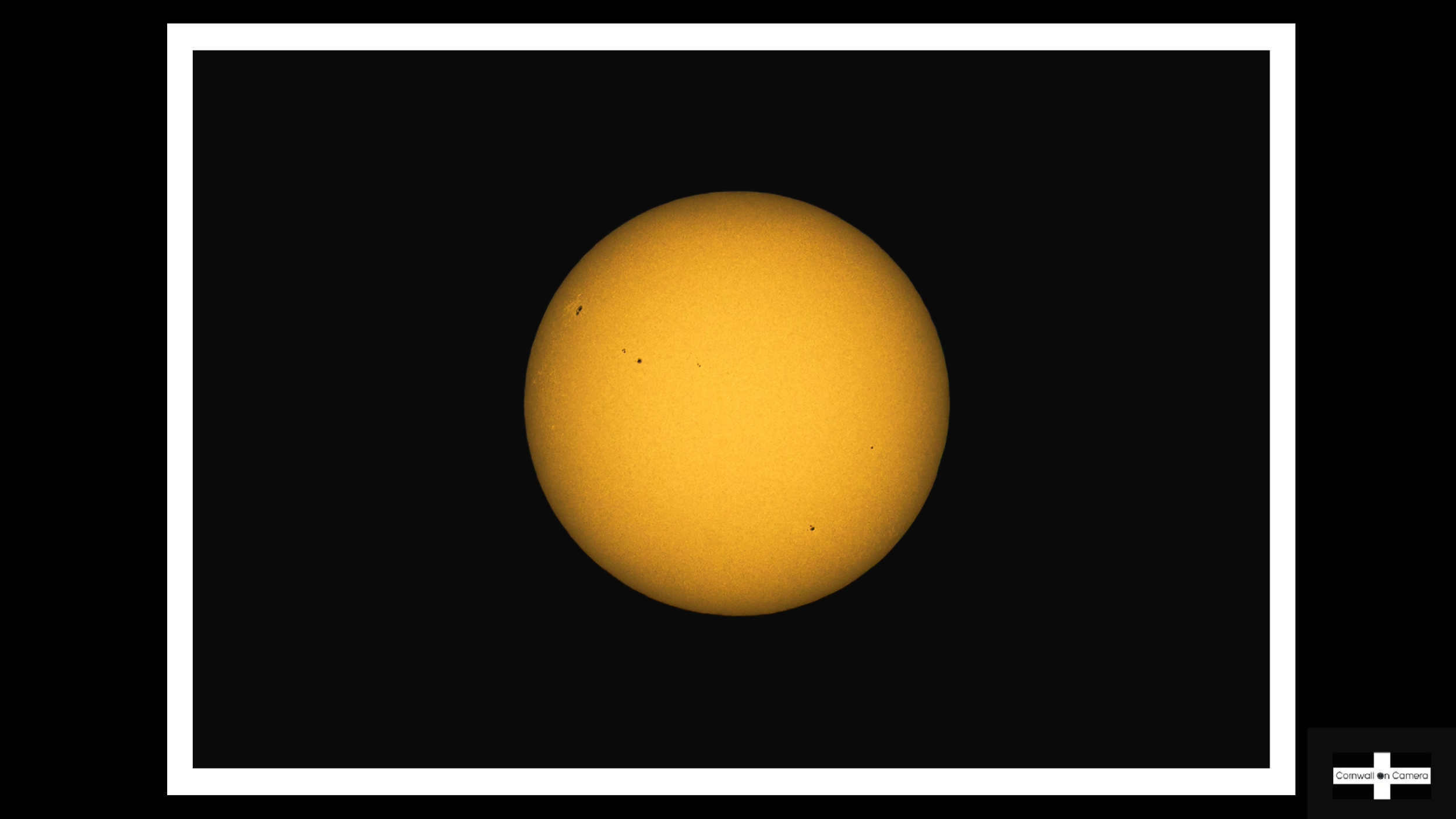
First contact was expected at approximately 6:19pm.
Through the solar filter, the Sun initially appeared as a complete golden disc, marked by several dark sunspots. Then a tiny section disappeared from its edge.
The Moon had arrived.
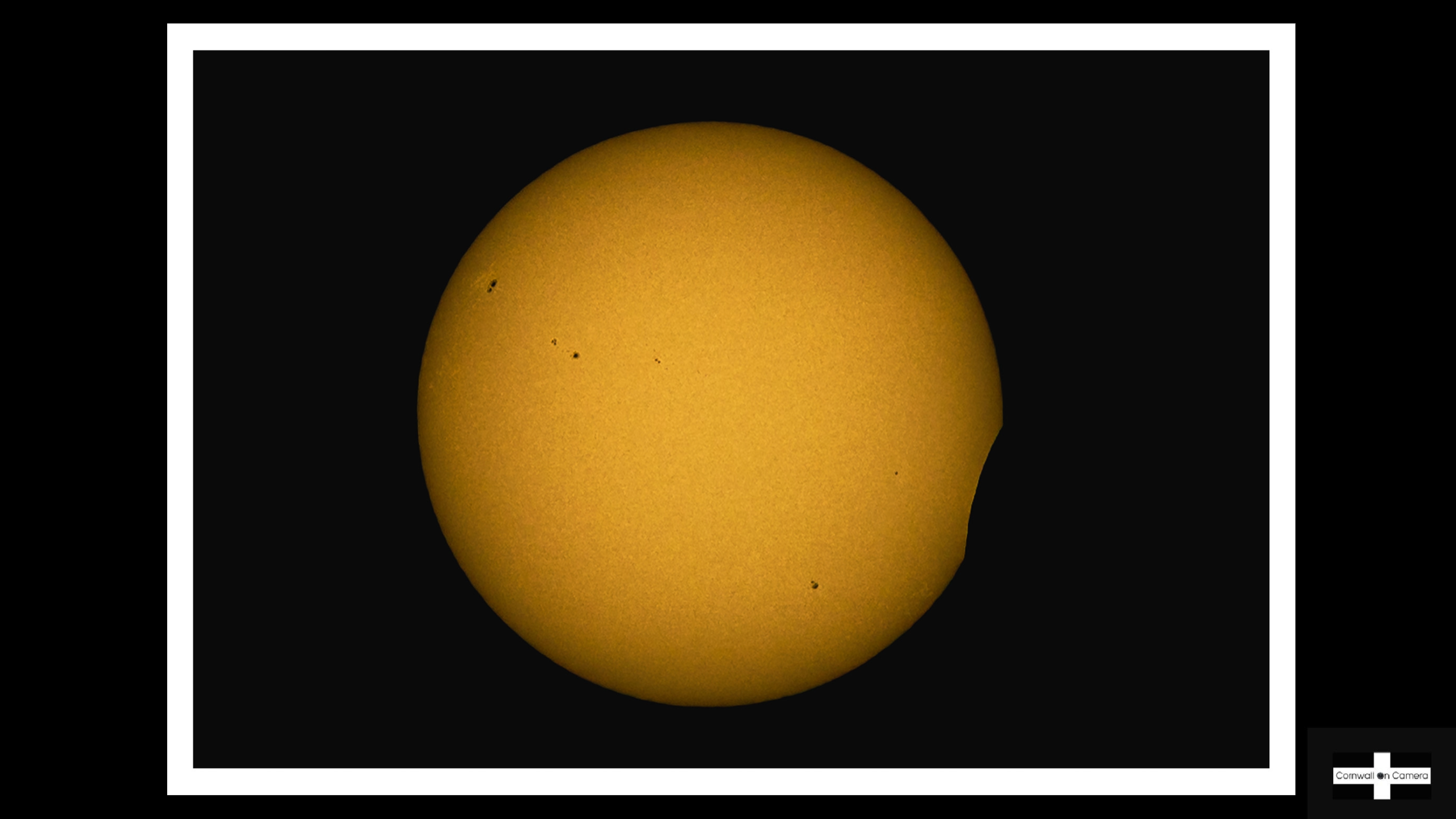
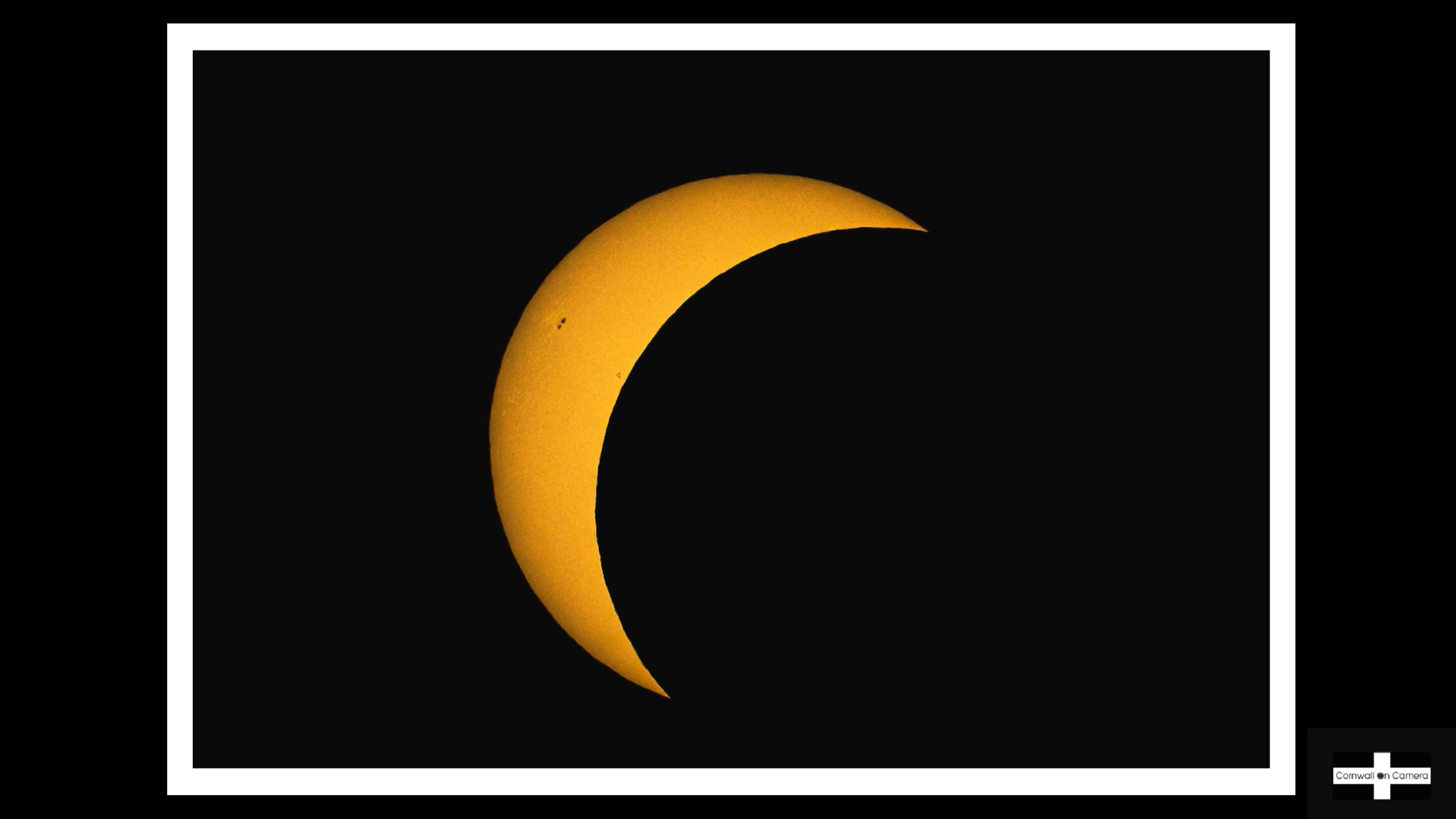
Over the following hour, that small indentation steadily deepened. The circular solar disc became a crescent, and the crescent gradually narrowed into a delicate arc of filtered sunlight.
The photographs looked remarkable on the back of the camera—but the transformation taking place across the landscape was equally fascinating.
When the Light Became Strange
At first, nothing around me appeared dramatically different.
The camera filming me automatically compensated for the falling light, making the scene look brighter than it appeared to my eyes. Yet as maximum eclipse approached, the change became impossible to ignore.
Long shadows stretched across the land. The light took on the softness of golden hour, despite the Sun remaining relatively high in the sky.
Eventually, I realised how best to describe it.
The entire world looked as though I were wearing sunglasses in bright daylight.
There were other changes too. I heard what sounded like a collection of chickens suddenly making a tremendous noise somewhere nearby. Seagulls circled above Carn Brea before gradually disappearing, and the landscape became remarkably quiet.
By the time the eclipse reached its deepest phase, I could no longer hear any birdsong.
People stood silhouetted along the Carn Brea ridge, watching the narrowing crescent above them. Even from across the valley, their excitement was obvious.
For reasons I still cannot entirely explain, I found myself speaking more quietly. The landscape had taken on an atmosphere that felt peaceful, strange and slightly eerie.
The Great Wheal Uny Sandwich Robbery
Of course, no photography adventure is complete without something unexpected happening.
My partner Kerry had brought me a sandwich and a drink from further up the hill. I placed the sandwich down for a moment while adjusting one of the cameras.
That was all the opportunity a passing dog required.
It appeared, grabbed the sandwich and accelerated down the path at approximately Warp Factor Nine, carrying its prize with it.
The owners were mortified. I found the entire incident hilarious.
Fortunately, I had a second sandwich, so the great eclipse expedition was able to continue without its photographer starving to death.
Maximum Eclipse
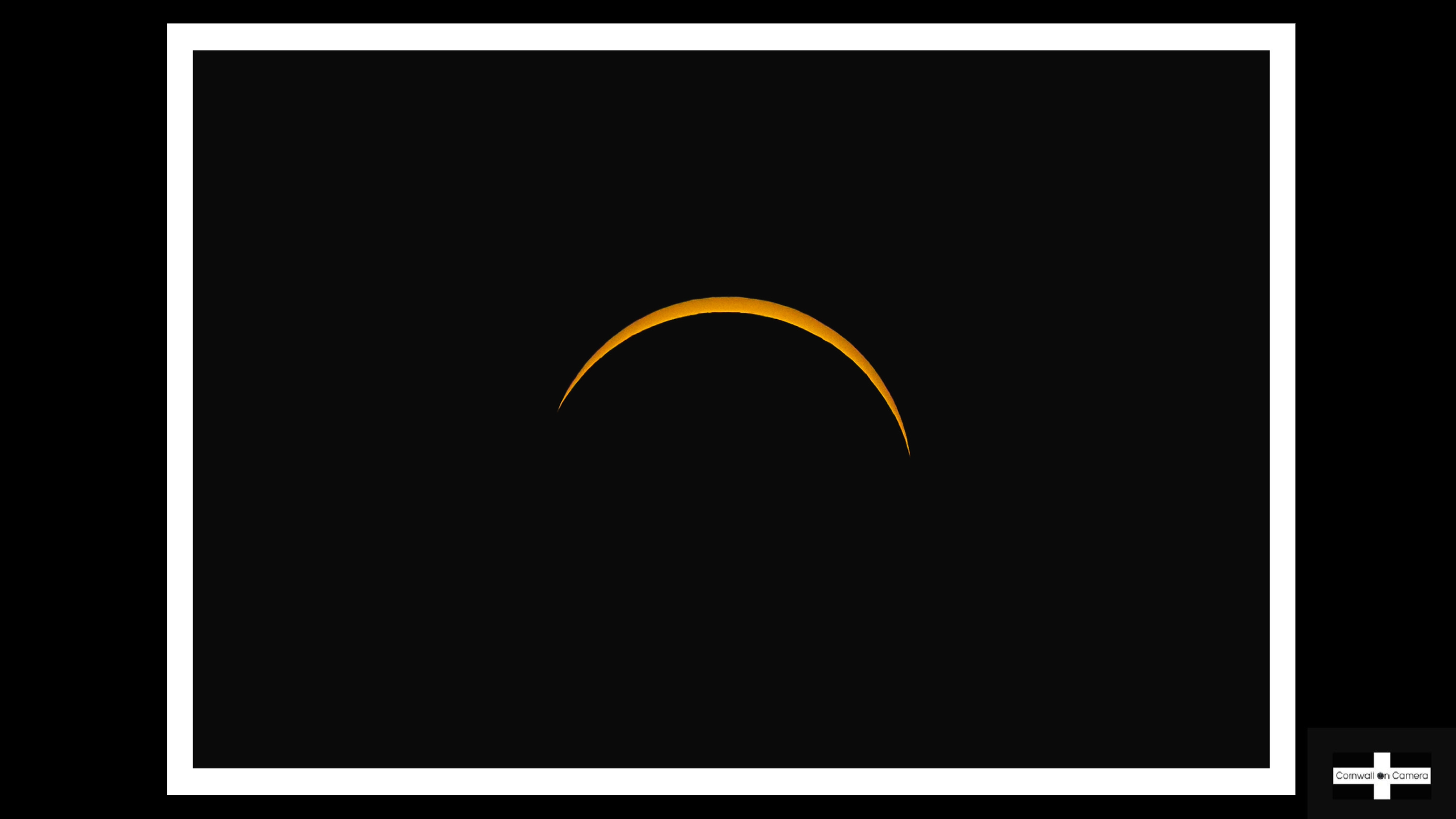
At maximum coverage, only a slender golden arc of the Sun remained visible.
This was not totality. The corona did not appear and the sky did not become completely dark. Solar glasses and camera filters still had to remain in place.
Nevertheless, seeing approximately 95–96% of the Sun hidden behind the Moon was extraordinary.
The most intense phase passed quickly. Within only a few minutes, the landscape began to brighten again. The difference was immediately apparent—not only towards Carn Brea, but across the fields beside me.
One practical lesson emerged later when I discovered that the clock in my EOS R had been running ten minutes fast. The eclipse itself had behaved perfectly; the photographer’s equipment had introduced the confusion.
Synchronising every camera clock is now firmly on my checklist for future events.
The Timelapse
The Canon 6D continued photographing long after maximum eclipse.
The resulting 25-second timelapse became one of my favourite pieces from the evening. The Sun enters the frame as the landscape begins to dim, moves down and to the right of Carn Brea, and then brightens again as the Moon begins to uncover it.
It does not show the detailed movement of the Moon across the solar disc. That was never its main purpose.
Instead, it records the eclipse’s effect upon the landscape—the subtle fading and restoration of daylight that was so difficult to capture on an automatically exposed video camera.
Creating the Final Carn Brea Composite
A solar filter is so dark that it records the Sun while leaving the surrounding landscape almost completely black. A correctly exposed foreground photograph, meanwhile, would render the unfiltered Sun as a featureless white glare.
Capturing both elements correctly in a single exposure was therefore not realistic.
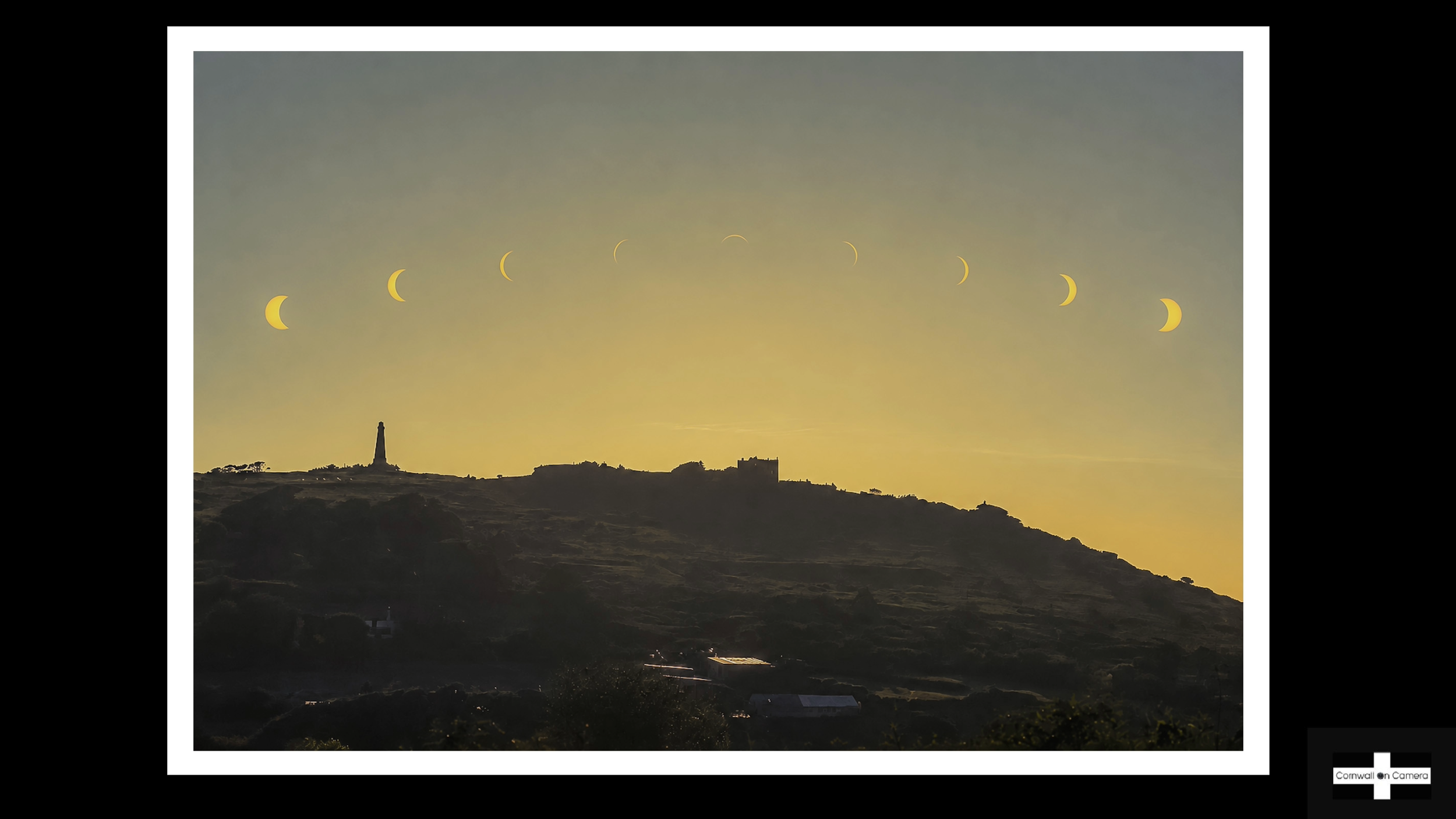
The final Carn Brea image is a photographic composite. It combines a foreground frame with nine solar-filtered photographs captured during the same eclipse from the same location.
The eclipse phases have been arranged across the sky to illustrate the event, with maximum eclipse positioned above Carn Brea Castle. Their placement is creative rather than a literal record of the Sun’s precise positions.
I believe that distinction matters.
Composite photography is a completely valid way of creating an image, particularly when dealing with subjects that require radically different exposures. The important thing is to be open about how the finished photograph was made.
What the Eclipse Taught Me
This was my first serious attempt at photographing a solar eclipse, and several lessons will remain with me:
Arrive early and give yourself time to solve problems.
Use a properly secured solar filter and check it repeatedly.
Run a second camera if you want to record the wider experience.
Synchronise the clocks in every camera before the event.
Allow enough space in a timelapse composition for the Sun’s movement.
Photograph the landscape separately if you intend to create a composite.
Never leave a sandwich unattended near an opportunistic dog.
Most importantly, I learned that planning cannot guarantee success—but it places you in the best possible position when the conditions finally cooperate.
Avenging 1999
In 1999, the clouds won.
In 2026, Cornwall gave me clear skies, a remarkable change in light, detailed images of the eclipsed Sun and a timelapse that worked more or less as I had hoped.
I returned home tired, sunburnt, missing half my food and desperate to see what was on the memory cards.
The eclipse had been photographed.
The timelapse had worked.
And after twenty-seven years, 1999 had finally been avenged.