
There are twenty photographs on my screen.
In every one of them, Wheal Edward is empty.
I know because I have searched them properly—not glanced, not casually zoomed in and satisfied myself that nothing obvious is standing beside the engine house. I have examined every doorway, every broken wall and every patch of darkness along the path.
Nothing changes between the frames.
Nothing emerges from the ruins.
Nobody is there.
That should make me feel better.
It doesn’t.
I am not frightened of the dark. That is important.
I have spent too many nights alone with it, waiting for the Milky Way to move into position above some abandoned engine house, ancient monument or lonely stretch of Cornish coast. I know the sounds that cliffs make after midnight. I know how distant waves can seem close and how an unexpected bird can remove several years from a man’s life when it erupts from the undergrowth beside him.
Darkness has never felt threatening to me. It is simply where some of my best photographs exist before I arrive to collect them.
That night at West Wheal Owles should have been no different.
I had invited several people who had previously expressed an interest in astrophotography. Unfortunately, their enthusiasm did not survive contact with the reality of walking around an abandoned mine beside an Atlantic cliff in the middle of the night.
So I went alone.
The National Trust had roped off the area immediately surrounding West Wheal Owles to protect nesting choughs. I wasn’t going to cross the barrier, so I continued past West Wheal Owles and Wheal Edward until I reached another path that curved back beneath the engine house.
I knew the route. I knew the landscape. I had photographed there many times before.
But a familiar place changes when your headlamp becomes the only light in it.
The lamp did not reveal the landscape so much as remove a small piece of darkness from directly in front of me. Everything beyond that circle ceased to have distance or shape. The fields, mine workings and cliffs still existed, but only because I remembered where they were.
My boots sounded ridiculously loud against the stony path.
Each step cracked through the silence and disappeared.
Nothing answered.
I reached the lower path and began walking back towards Wheal Owles.
That was when the lights appeared.
Two of them.
Small, amber and side by side.
They were not bright enough to be a torch. There was no beam and no surrounding glow. They illuminated neither ground nor wall, and I could see no person holding them.
My first thought was eyeshine. There was open ground to the left of the path, and an animal looking towards my headlamp could easily produce two points of reflected light.
Then they disappeared.
I continued forward.
The path ran between old stone walls before bending slightly left towards an intersection. As I approached it, the amber lights appeared again.
This time they seemed higher.
Much higher.
For a moment, the only shape my brain could give them was a person standing near the end of the wall, holding a light above their head at arm’s length.
“Shit,” I thought. “There’s another photographer here.”
Perhaps they were warning me that they had a camera exposing. I lowered my headlamp towards the ground so that I wouldn’t destroy their night vision or shine light into their composition.
The two amber points remained exactly where they were.
I kept walking, watching them above the lowered beam.
Five seconds.
Ten.
Perhaps fifteen.
Then both went out together.
Not dimmed.
Not moved away.
Gone.
I reached the end of the wall expecting to find someone standing beyond it.
There was nobody there.
I swept the area with my headlamp.
Empty path. Empty intersection. Heather, grass, stone and the fragmented remains of the old mine. There was no torch moving away and no figure crossing the open ground.
More importantly, there was no sound.
Nobody could have moved quickly across that terrain without disturbing loose stone or vegetation. Moving without a light would have been reckless. Even with good night vision, one wrong step out there does not necessarily end with a grazed knee. It can end at the bottom of a cliff.
I stood and listened.
The silence felt enormous.
My breathing seemed too loud for it. The movement of my clothes sounded like somebody standing immediately behind me.
There was nobody there.
I knew that.
This was not fear of ghosts. At no point had I considered anything supernatural. If ghosts exist, I’m not convinced they can do much to me.
People are different.
Somewhere between seeing the lights and arriving at the empty wall, my brain had quietly reached a conclusion without consulting me:
There is somebody out here.
You don’t know where they are.
You don’t know what they want.
I could have returned to the car.
Instead, I looked towards West Wheal Owles and the Milky Way above it.
A photograph still needed taking.
Alive or dead, nothing was stopping the photography.
I followed the path beneath the engine house and found the position I had planned. The familiar ritual helped: tripod legs spread firmly, camera secured, composition adjusted, stars magnified and brought carefully into focus.
Through the camera, the landscape became manageable again.
There were edges. Shapes. A frame around it.
The first exposure began.
For several seconds I stood completely still, listening to the camera measure out the darkness.
The shutter closed.
Another exposure started.
That was when I heard the voices.
They were faint and somewhere ahead of me, close enough to resemble conversation but too indistinct to understand. One voice seemed to rise, another to answer, and then both dissolved into the silence.
I turned towards the sound.
“Hello?”
Nothing responded.
I swept the engine house and the surrounding path with my headlamp.
Nothing.
The sea was the obvious explanation. I had experienced something similar years earlier while photographing the abandoned buildings at Kennall Vale. The river had been flowing through the darkness, its constantly changing frequencies arranging themselves into what sounded uncannily like distant human speech.
Water can do that.
The Atlantic could certainly do it.
So could seabirds or wind passing through the broken masonry.
I knew all this.
Then the voices returned.
Again, there were no words—only the unmistakable rhythm of people talking somewhere beyond the reach of my light.
My skin tightened across the back of my neck.
The night no longer felt empty.
It felt as though everything outside the camera’s frame was waiting for me to look away.
I continued shooting.
By then every sense had been turned up far beyond a useful level. Tiny changes in the wind demanded my attention. A settling stone became a footstep. The movement of vegetation became somebody repositioning themselves in the darkness.
The camera continued taking photographs.
Eventually the sequence finished.
I packed the equipment and headed back towards Wheal Edward. The lights did not return. The voices had stopped.
The feeling had not.
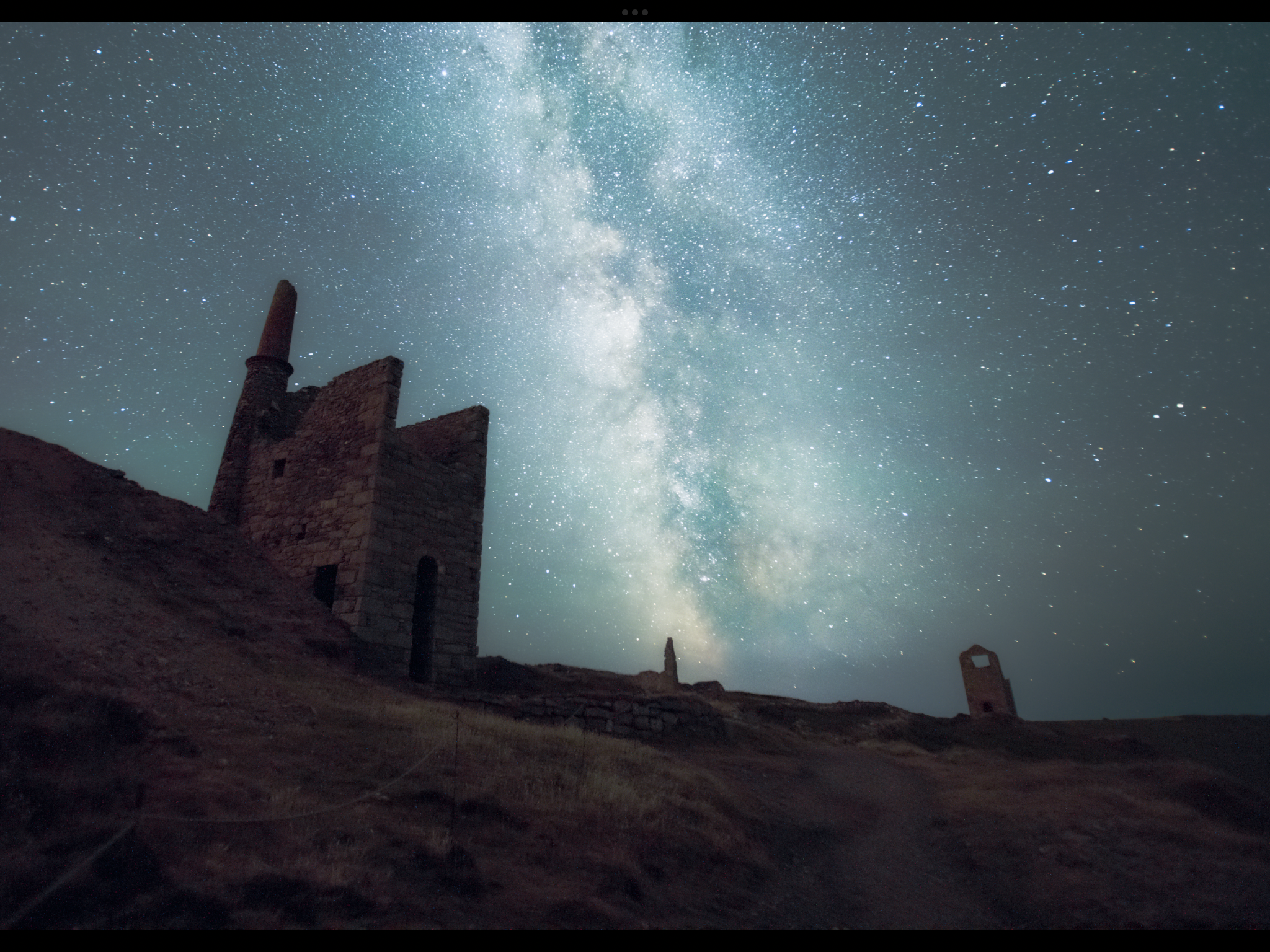
Wheal Edward stood alone against the stars, its empty windows open to the sky. I found my position and rebuilt the tripod.
Normally, I would take ten photographs for a stack. Ten had always produced a decent result, but I had recently been experimenting to improve the final image. More frames meant cleaner detail and less noise.
That night, without giving the number any particular thought, I decided to take twenty.
The camera began.
One frame.
Two.
Nothing moved around the engine house. No lights appeared along the paths. No voices reached me from the cliff.
Five frames.
Six.
The silence should have been reassuring, but it had become something else. It felt deliberate, as if the landscape were holding itself still.
Ten frames.
Halfway.
The rational part of my mind continued supplying explanations. An animal had produced the lights. Waves had produced the voices. My discomfort was simply the fight-or-flight response, triggered by uncertainty and now searching desperately for evidence that it had been right.
Eleven.
Twelve.
Knowing how the mind works does not always stop it working.
I felt watched.
Not from one particular window or ruin, but from the darkness surrounding all of them.
Something in me kept repeating a single instruction:
Leave.
I watched the exposure count rise.
Sixteen.
Seventeen.
I began packing everything that the camera did not currently need.
Eighteen.
The path behind me remained empty.
Nineteen.
The final exposure began.
For several seconds, Wheal Edward and I stood facing one another in the dark.
The shutter closed.
Twenty.
I removed the camera, collapsed the tripod and started walking.
The discomfort eased slightly when I reached the main track. I turned towards the upper path leading back to the car.
Nothing followed.
Nothing appeared behind me.
I had almost convinced myself that the night was over when something began running along the parallel path below.
It sounded heavy.
Not a rabbit disappearing into the gorse, but something larger moving quickly across uneven ground.
I stopped and swung my headlamp towards the sound.
The beam crossed the lower path, stone walls and vegetation.
Nothing was there.
The running stopped.
I waited for it to start again.
It didn’t.
I reached the car without further incident and left.
Later, I examined all twenty photographs from Wheal Edward. If anybody had been around the engine house, there was no sign of them. The paths were empty, the windows black and the surrounding land completely still.
Twenty photographs.
Nothing in any of them.
Only afterwards did I begin looking more deeply into the history of Wheal Owles.
I already knew about the disaster of 10 January 1893. What I had not known was what happened in the days before it.
A miner named Thomas Henry Lutey reportedly experienced some kind of premonition. He ran through one of the underground levels, terrifying his companions by shouting:
“Water! Water!”
Days later, men working deep within Wheal Owles blasted through rock and broke into the flooded workings of neighbouring Wheal Drea.
The water did not creep gradually into the mine.
It arrived with a roar.
The pressure forced air through the workings with enough violence to extinguish the miners’ candles, leaving them to find the shafts and ladders in complete darkness. Some escaped. One group used the rails beneath an empty wagon to guide themselves towards the shaft because they could no longer see the route.
Those working on the lower levels never came out.
I have been underground in several mines. People often imagine large tunnels where a person can stand upright and walk freely. Some passages are like that.
Many are not.
They are tight, uneven and oppressive. You bend forward beneath the weight of the rock. In places you crawl. The ceiling presses close to your back and the walls decide how your body is allowed to move.
I love the sea. I can swim reasonably well.
I also have a deep and completely unreasonable fear of drowning.
Perhaps it is not the water itself that frightens me. Perhaps it is the moment when water takes away every choice: no space, no direction, no air and no way to reason with what is happening.
I cannot imagine those final moments beneath Wheal Owles without feeling something cold tighten inside me.
The darkness.
The shouting.
Men searching for ladders they could no longer see.
Water filling passages through which they could barely move quickly when dry.
Nineteen men and a fifteen-year-old boy died underground that morning.
Their bodies were never recovered.
Twenty people remain somewhere beneath that landscape.
Twenty.
I looked back at the photographs on my computer.
I normally took ten frames.
That night, without thinking about the disaster or the people who had died there, I had taken twenty.
It is a coincidence.
Of course it is.
The lights were probably an animal’s eyes reflecting the edge of my headlamp beam. Although they remained visible for ten or fifteen seconds after I lowered it.
They might have belonged to a boat farther offshore than they appeared. Although I believed I saw them above a wall with rising ground behind it.
The voices were waves breaking against the cliffs and returning through the mine ruins as fractured echoes.
The running was an animal moving through the vegetation.
My brain had taken those unrelated events, joined them into a single threat and placed every sense on Red Alert. Once that happened, every sound became evidence and every blind corner contained a person who was not there.
That is the logical explanation.
I believe it.
I genuinely do.
But memory is a dangerous thing.
I did not hear words beneath West Wheal Owles that night. I am certain of that. The sounds only resembled a conversation whose meaning remained just beyond reach.
Then I learned about Lutey’s warning.
“Water! Water!”
Now, when I remember those voices, my mind tries to give them words.
I refuse to let it.
Perhaps that is what a haunting really is.
Not the dead walking or calling from beneath the ground, but knowledge arriving afterwards and changing the shape of something you thought you understood.
There are twenty photographs on my screen.
In every one of them, Wheal Edward is empty.
No figure stands beside the ruined walls. Nobody watches from the windows. Nothing waits along the path.
The camera recorded exactly what was there.
Starlight.
Stone.
Darkness.
And nothing else.
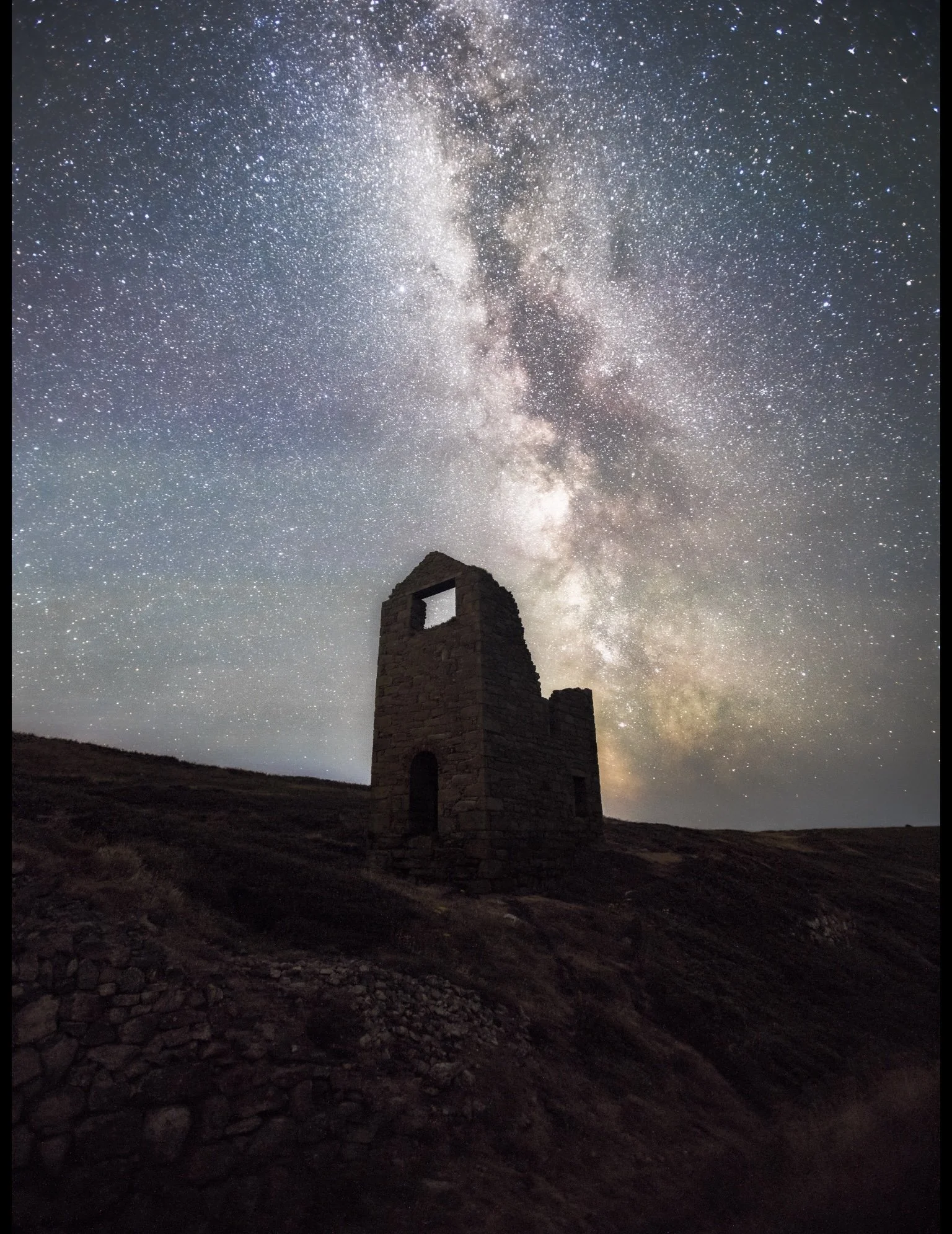
Wheal Edward beneath the Milky Way — the final image created from twenty stacked frames.
I intend to return.
Not to search for ghosts, but to stand at that intersection again and determine what produced those two amber lights. Next time I will switch my headlamp off completely. I will watch their position against the wall. If they appear, I will photograph them.
Because whatever happened that night, one fact remains beyond dispute:
Alive or dead, nothing stops the photography.
Although next time, I might take twenty-one frames.
Historical note: The Wheal Owles disaster of 1893
On 10 January 1893, miners working in the Cargodna section of Wheal Owles accidentally broke through into the abandoned, flooded workings of neighbouring Wheal Drea. The sudden inrush of water drove air through the mine and extinguished the miners’ lights. Nineteen men and a boy lost their lives. Their bodies were never recovered, and the mine closed following the disaster.
The events described in Twenty Frames are my own recollection of a night photographing West Wheal Owles and Wheal Edward. I cannot explain the lights with certainty, but I make no claim that anything supernatural occurred.